English (UK)
  Türkçe
  Русский
  Italiano
  Deutsch
  Español
  العربية
  Français


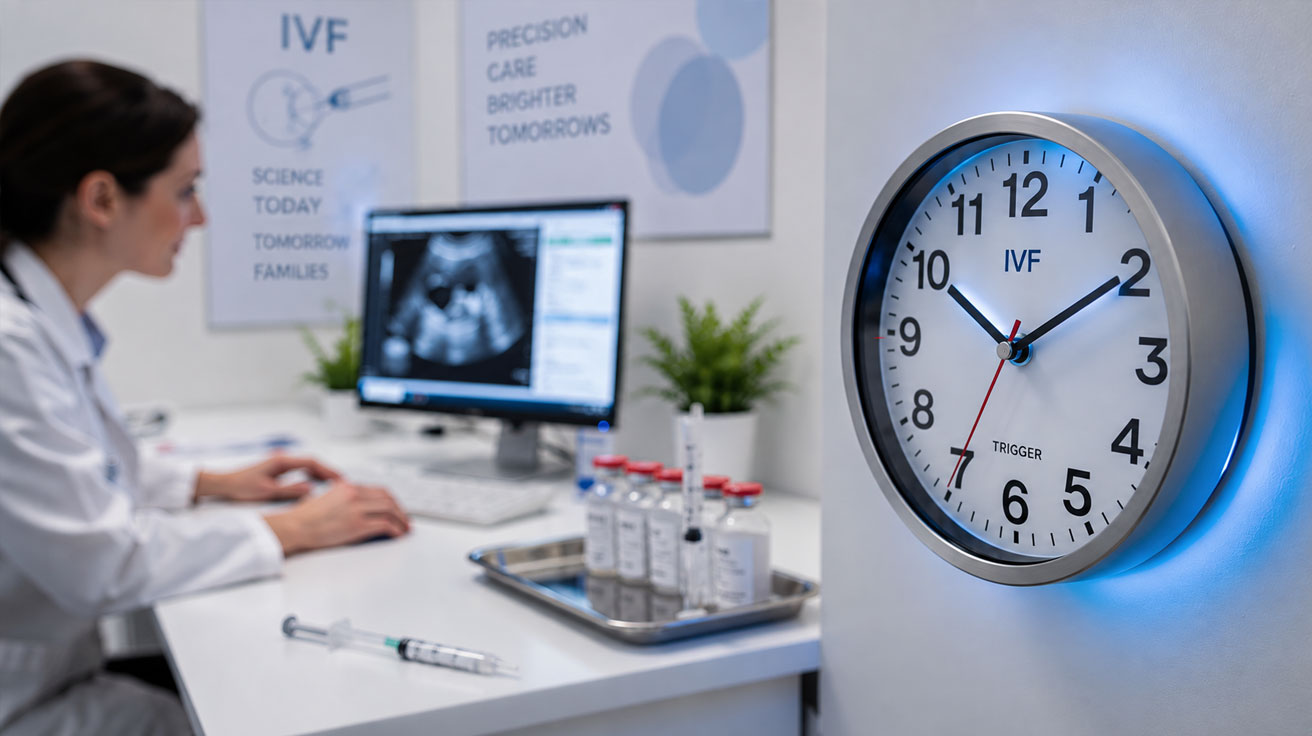
One of the most important moments in an IVF cycle occurs approximately 36 hours before egg retrieval. By this stage, ovarian stimulation has already encouraged a group of follicles to grow. However, having follicles of an appropriate size does not necessarily mean that the oocytes inside them are mature. The final transition of the oocyte into the metaphase II (MII) stage, the stage at which it can normally undergo fertilization with ICSI, depends heavily on the hormonal events initiated by the trigger injection.
For most patients, a conventional trigger works very well. In selected patients, however, particularly when previous treatment has produced an unexpectedly high proportion of immature oocytes, we may consider a different approach known as a dual trigger.
Rather than relying on a single pathway, a dual trigger combines human chorionic gonadotropin (hCG) with a GnRH agonist. With this strategy, we are interested in whether we can increase the proportion of retrieved oocytes that successfully complete final nuclear maturation and reach the MII stage.
What Actually Happens After the Trigger?
During a natural menstrual cycle, final oocyte maturation occurs in response to the mid-cycle gonadotropin surge. Although the LH surge receives most of the attention, there is also a smaller accompanying FSH surge. These hormonal signals initiate a sequence of events within the follicle, including cumulus expansion, germinal-vesicle breakdown, resumption of meiosis and progression of the oocyte toward metaphase II.
Traditional IVF triggering uses hCG because hCG binds to the LH/hCG receptor and provides a powerful and relatively long-lasting LH-like signal. This approach has been used successfully for decades.
A GnRH agonist trigger works differently. In a GnRH antagonist IVF cycle, administration of a GnRH agonist causes the patient’s pituitary gland to release a short endogenous surge of both LH and FSH. The hormonal pattern therefore resembles the physiological mid-cycle gonadotropin surge more closely than hCG alone.
The additional FSH surge may be particularly relevant. Although FSH is primarily associated with follicular recruitment and growth during ovarian stimulation, its physiological role does not necessarily end once the follicles have grown. The periovulatory FSH surge appears to participate in processes associated with final follicular maturation, including cumulus expansion and the acquisition of LH receptors by granulosa cells.
This provides part of the biological rationale for dual triggering. With hCG alone, we provide strong and prolonged LH/hCG-receptor stimulation, but we do not reproduce the endogenous FSH surge. Adding a GnRH agonist allows the pituitary to release both LH and FSH while the simultaneously administered hCG provides more sustained LH/hCG-receptor stimulation.
In other words, the two medications generate different but potentially complementary endocrine signals.
The Importance of Trigger Timing
Even the most sophisticated trigger strategy cannot compensate for inappropriate timing. During ovarian stimulation, follicles do not all grow at exactly the same rate. At the time of triggering, the ovary normally contains a distribution of larger, intermediate and smaller follicles. The objective is therefore not necessarily to wait for every follicle to reach a particular diameter, but to identify the point at which the overall follicular cohort has the greatest probability of yielding mature oocytes.
Trigger too early and a greater proportion of oocytes may not have acquired sufficient developmental competence to complete maturation. Trigger too late and some of the leading follicles may become post-mature, luteinize prematurely or, occasionally, ovulate before retrieval.
For this reason, trigger timing should not be determined by one follicle alone. We assess the distribution of follicle sizes, number of follicles, hormonal profile, ovarian reserve, previous IVF response and the patient’s age.
In our practice, we generally aim for the majority of the clinically relevant follicular cohort to be approximately 16–21 mm when the trigger is administered, followed by egg retrieval approximately 35–36 hours later. However, there are situations in which we deliberately trigger somewhat earlier. In older patients, particularly when there is concern regarding premature luteinization or when previous cycles suggest that waiting for the largest follicles to reach conventional trigger dimensions may compromise the remainder of the cohort, we may consider triggering when a greater proportion of follicles are approximately 14–18 mm. This is an individualized clinical strategy rather than a universal follicle-size rule.
Age adds another layer of complexity. Aging primarily affects oocyte competence and chromosomal integrity, and a dual trigger cannot reverse age-related aneuploidy. Nevertheless, abnormalities of oocyte maturation can also occur, and some studies suggest that oocyte immaturity becomes more prominent at more advanced reproductive ages. This does not mean that every older patient has an oocyte-maturation problem, but when relatively few oocytes are available, optimizing the probability that each retrieved oocyte reaches MII becomes increasingly important.
Dual Trigger Strategy
When we decide that a dual trigger is appropriate, our commonly used combination is: Decapeptyl (triptorelin) 0.2 mg + Ovitrelle (choriogonadotropin alfa) 250 micrograms administered according to the prescribed trigger schedule. Doses are not fixed. They can be adjusted based on the number of follicles and the patient’s previous IVF history. Above numbers are just to give the reader some idea of a typical dual trigger strategy.
Ovitrelle provides recombinant hCG activity and therefore sustained stimulation of the LH/hCG receptor. Decapeptyl is a GnRH agonist. When used in an antagonist cycle, it stimulates the pituitary to generate an endogenous surge of LH together with an accompanying FSH surge. The intention is therefore to combine the sustained LH-like activity of hCG with the endogenous LH and FSH surge produced by the GnRH agonist.
The strategy can be particularly interesting when a previous IVF cycle has demonstrated a discrepancy between follicular development and the final laboratory outcome. For example, a patient may develop an apparently satisfactory number of mature-sized follicles but retrieve considerably fewer oocytes than expected. Alternatively, an appropriate number of oocytes may be retrieved but an unexpectedly large proportion may remain at the germinal-vesicle (GV) or metaphase-I (MI) stage rather than progressing to MII.
Previous cycle behavior is therefore extremely informative. If ten appropriately developed follicles produce eight oocytes but only three or four are mature, simply increasing the gonadotropin dose in the next cycle may not address the underlying problem. The issue may lie partly in the final maturation process rather than follicular recruitment. This is where modifying the trigger strategy becomes biologically plausible.
At the same time, dual trigger should not be confused with a treatment for age-related oocyte quality. It cannot correct meiotic chromosomal errors or convert an aneuploid oocyte into a euploid one. Rather, the objective is to maximize the probability that oocytes capable of completing maturation receive an appropriate final maturation signal.
What Clinical Studies Show
Several clinical studies support this strategy, particularly in patients who have previously demonstrated suboptimal oocyte maturation. One of the most clinically relevant studies was published by Griffin et al. in Fertility and Sterility in 2014. The investigators studied patients who had previously retrieved more than 25% immature oocytes following conventional triggering. When these patients subsequently received a combined GnRH agonist and hCG trigger, the median proportion of mature oocytes increased from 38.5% to 75.0%. After adjustment for potential confounding factors, dual triggering was associated with approximately 2.5-fold greater odds of obtaining a mature oocyte. This study is particularly interesting because it focused on women who had already demonstrated a maturation problem rather than applying dual triggering indiscriminately to an unselected IVF population.
Similar findings were reported by Zilberberg et al., who investigated patients with a previously low proportion of mature oocytes. Combined GnRH agonist and hCG triggering was associated with improvements in MII oocyte numbers and other embryological parameters. These observations helped establish the concept of dual triggering as a potential strategy for a recognizable poor-oocyte-maturation phenotype, rather than simply an additional medication to be given to everyone.
Another clinically interesting situation is when the number of retrieved oocytes is unexpectedly low compared with the number of developed follicles. Haas et al. studied patients with a previous low oocyte yield relative to the number of preovulatory follicles and reported improved oocyte retrieval following combined GnRH agonist and hCG triggering. This raises the possibility that trigger strategy influences not only nuclear maturation but also cumulus expansion and the biological processes that allow the cumulus-oocyte complex to detach appropriately from the follicular wall.
Randomized trials have also provided supportive evidence. In a double-blinded randomized controlled study published in Human Reproduction in 2020, Haas and colleagues compared hCG alone with combined GnRH agonist/hCG triggering. The average number of mature MII oocytes increased from 8.6 with hCG alone to 10.3 with dual trigger, and the dual-trigger group also produced more retrieved oocytes, fertilized oocytes, blastocysts and top-quality blastocysts.
A separate 2020 randomized controlled trial by Ali et al. in normal responders undergoing antagonist ICSI cycles similarly reported significantly greater numbers of retrieved oocytes and MII oocytes with dual triggering, although fresh-cycle implantation, clinical pregnancy and live-birth rates were not significantly different between groups.
The evidence becomes particularly compelling when we specifically examine patients with a previous high immature-oocyte rate. In a randomized controlled trial published by Yan et al. in 2023, women younger than 40 who had experienced more than 50% immature oocytes in their previous cycle were randomized to conventional hCG or dual triggering. The oocyte maturation rate increased from 55.5% with hCG alone to 84.0% with the dual-trigger strategy, despite there being no significant difference in the total number of oocytes retrieved. The study also reported higher cumulative pregnancy and live-birth rates in the dual-trigger group.
There is also evidence specifically relevant to older patients with diminished ovarian reserve. Chern et al. examined 384 cycles fulfilling POSEIDON group 4 criteria. Patients receiving a dual trigger had significantly greater numbers of retrieved oocytes, MII oocytes, fertilized oocytes and embryos than patients receiving hCG alone. Importantly, however, this was a retrospective cohort study rather than a randomized trial, so the findings demonstrate an association rather than proving that the trigger strategy itself produced all of these differences.
Taken together, the literature suggests that dual triggering can improve oocyte yield and/or MII oocyte numbers in some populations, with perhaps the clearest clinical rationale in patients who have already demonstrated an unexpectedly high proportion of immature oocytes. It does not, however, establish that dual triggering is universally superior for every IVF patient.
And this is precisely why we do not use a dual trigger automatically in every treatment cycle.
For many patients, conventional hCG triggering already produces an excellent MII rate. Adding another medication when the existing strategy is working appropriately may provide little additional benefit. More importantly, the choice of trigger also has implications for OHSS risk. One of the major advantages of a GnRH-agonist-only trigger in high responders is the marked reduction in OHSS risk compared with hCG exposure. Reintroducing hCG as part of a dual trigger changes that safety profile.
A patient with diminished ovarian reserve and four developing follicles therefore presents a very different clinical situation from a young patient with 25 developing follicles and a high estradiol level. The optimal trigger for one is not necessarily the optimal trigger for the other.
Ultimately, oocyte maturity depends on much more than the trigger medication itself. Follicular synchronization, gonadotropin exposure, LH activity, follicular growth pattern, hormone levels, follicular size at triggering and the interval between trigger and retrieval all contribute to the final result.
The objective should therefore not be to use the most medications possible, but to retrieve the largest reasonable number of developmentally competent, mature oocytes from the follicular cohort that the patient has produced. For many patients, a conventional trigger accomplishes this perfectly well. For others, particularly those who have previously demonstrated a discrepancy between follicular development and oocyte retrieval, or an unexpectedly high proportion of immature oocytes, the combination of sustained hCG activity with the endogenous LH and FSH surge generated by a GnRH agonist provides a physiologically plausible and increasingly evidence-supported strategy for improving final oocyte maturation.
Dr. Ahmet Ozyigit, MD
MSc Clinical Embryology, PgDip Endocrinology, FAAMM, ABAARM
Elite Research and Surgical Hospital
References
- Griffin D, Feinn R, Engmann L, Nulsen J, Budinetz T, Benadiva C. Dual trigger with gonadotropin-releasing hormone agonist and standard dose human chorionic gonadotropin to improve oocyte maturity rates. Fertility and Sterility. 2014;102(2):405–409. DOI: 10.1016/j.fertnstert.2014.04.028
- Zilberberg E, Haas J, Dar S, Kedem A, Machtinger R, Orvieto R. Co-administration of GnRH-agonist and hCG, for final oocyte maturation, in patients with low proportion of mature oocytes. Gynecological Endocrinology. 2015;31(2):145–147. DOI: 10.3109/09513590.2014.978850
- Haas J, Zilberberg E, Dar S, et al. Co-administration of GnRH-agonist and hCG for final oocyte maturation in patients with low number of oocytes retrieved per number of preovulatory follicles—a preliminary report. Journal of Ovarian Research. 2014;7:77. DOI: 10.1186/1757-2215-7-77
- Haas J, Bassil R, Samara N, et al. GnRH agonist and hCG (dual trigger) versus hCG trigger for final follicular maturation: a double-blinded, randomized controlled study. Human Reproduction. 2020;35(7):1648–1654. DOI: 10.1093/humrep/deaa107
- Ali SS, Elsenosy E, Sayed GH, et al. Dual trigger using recombinant HCG and gonadotropin-releasing hormone agonist improve oocyte maturity and embryo grading for normal responders in GnRH antagonist cycles: Randomized controlled trial. Journal of Gynecology Obstetrics and Human Reproduction. 2020;49(5):101728. DOI: 10.1016/j.jogoh.2020.101728
- Chern CU, Li JY, Tsui KH, et al. Dual-trigger improves the outcomes of in vitro fertilization cycles in older patients with diminished ovarian reserve: a retrospective cohort study. PLOS ONE. 2020;15(7). DOI: 10.1371/journal.pone.0235707
- Hu KL, Wang S, Ye X, Zhang D, Hunt S. GnRH agonist and hCG (dual trigger) versus hCG trigger for follicular maturation: a systematic review and meta-analysis of randomized trials. Reproductive Biology and Endocrinology. 2021;19:78. DOI: 10.1186/s12958-021-00766-5
- Yan MH, Sun ZG, Song JY. Dual trigger for final oocyte maturation in expected normal responders with a high immature oocyte rate: a randomized controlled trial. Frontiers in Medicine. 2023;10:1254982. DOI: 10.3389/fmed.2023.1254982