 English
  Turkish
  Russian
  Italian
  German
  Spanish
  Arabic
  French


Gender Selection Programs at North Cyprus IVF Center
1) MicroSort IUI for Gender Selection (costs 3,000 Euros)
This treatment method is mostly suitable for fertile couples in their 20s, where the female patient’s ovarian reserves are still very well intact and a well response can be obtained with a very mild stimulation cycle. The male partner’s sperm count, concentration, motility and morphology are also very important when determining whether the sperm will be an ideal candidate for the MicroSort procedure or not. MicroSort procedure requires that the male partner has a semen sample which complies with minimum concentration, motility and morphology requirements.
MicroSort IUI works very much like regular IUI, where the female patient receives a very mild stimulation medication to produce multiple oocytes in order to increase the chances of pregnancy at the time of insemination. The MicroSorted sperm is injected intra-uterine in order to achieve pregnancy.
MicroSort for gender selection with IUI treatment has a high accuracy of gender selection (around 70% for a male child and 75-80% for a female child). Regarding success rates for achieving pregnancy, MicroSort IUI has similar success rates to IUI treatment success rates, which is about 20-25% for women younger than 35 years of age, and about 10-12% for women older than 35 years of age. Therefore, while MicroSort IUI provides a higher likelihood of having a child with desired sex, it does not offer a high success rate in terms of achieving a pregnancy. It should be kept in mind that MicroSort IUI may need several attempts before pregnancy can be achieved. If a higher chance of success is desired with gender selection treatments, IVF treatment should be considered rather than the non-invasive IUI.
2) MicroSort IVF for Gender Selection (Costs 4,200 Euros)
This treatment option is more like regular IVF-ICSI treatment. The male partner’s sperm is sorted into X and Y bearing cells for the gender selection aspect, just like in the IUI option. However, as opposed to injecting the sorted sperm trans-uterine, female partner’s eggs are taken out and the sperm is injected directly into the female partner’s eggs for fertilization. In other words, IVF+ICSI does not let nature take its course, but rather, does the job in the lab environment.
IVF treatment requires that the female partner uses stimulation medication in order to produce a higher count and quality of eggs in a given menstrual cycle. It is through this medication protocol that we are able to obtain a higher count of eggs in order to increase your chances of pregnancy.
Pregnancy rates with MicroSort IVF are considerably higher than IUI since IVF procedures allow for multiple eggs to be fertilized and transferred back into the uterus.
IMPORTANT DISCLAIMER ***
Due to legal considerations, we employ MICROSORT technologies ONLY as a gender selection method. However, it should be kept in mind that while PGT is not used for gender selection per se, it is still a very important component of our treatment program as it helps us choose the genetically healthy embryos for planning your pregnancy.
It is known that the risk of chromosomal aneuploidies (abnormalities) increases with age. As a woman ages, so do her eggs. This is called oocyte aging. Oocyte aging brings with it a number of problems:
– Increased rate of mitochondrial dysfunction
– Increased rate of chromosonal aneuploidy
– Increased rate of epigenetic problems.
As the oocyte ages, genetic problems are more pronounced. The graphic below displays the rate of chromosomal aneuploidy on embryos by maternal age:
Incidence of Chromosomal Aneuploidy with Age:
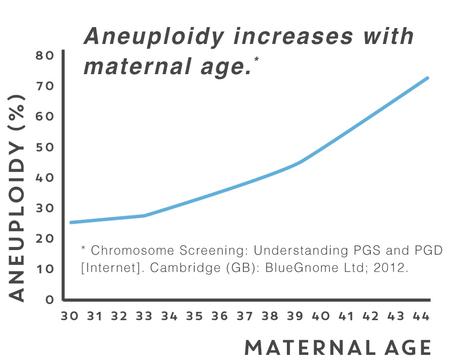
The figure indicates that when a woman is around the age of 30, about 25% of her embryos will have a genetic abnormality. This means that after an IVF treatment, about one-fourth of her embryos will be genetically abnormal.
At about 35 years of age, this number goes up to about 32%, meaning, approximately one in three embryos will have a genetic abnormality.
At the age of 42, approximately 60% of embryos during an IVF cycle will be abnormal.
In natural pregnancies, these embryos either do not generate a pregnancy, or they do not survive so they end up in a very early miscarriage.
During IVF treatments, it is very important that while selecting the sex of the baby, we also make sure that the embryos that we transfer into the uterus are genetically healthy. For this end, after selecting the sex of your baby with MicroSort, it is important to screen your embryos with PGT so that we can select the genetically healthy embryos for pregnancy.
3) MicroSort IVF with Pre-Implantation Genetic Testing (7,000 Euros)
Combining MicroSort and PGT is the gender selection method with highest precision and highest success rate. While MicroSort allows for majority of the embryos to fertilize into the desired sex, PGT allows us to select the healthy ones. While we don’t use PGT as a gender selection method on its own, it is a genetic technology that allows us screen the chromosomes of your embryos for major genetic disorders so that we can make sure your embryos are free of genetic disorders as well as being of desired sex.
Cost of Gender Selection at North Cyprus IVF Centre:
The cost of gender selection treatment depends on which treatment option is chosen. The cost of the medical treatments are specified next to each treatment heading. However, you should keep in mind that certain costs are not included in the provided quotes. These are:
-Cost of medication, which depends on the type of treatment and the dose of medication to be administered. It is very difficult to predict this before knowing the type of gender selection treatment you would like to opt for and your hormone levels, which will determine the dose that we will prescribe.
-Cost of your airfare and accommodation for the duration of your treatment. You will be expected to stay in Cyprus for about 8/9 days. For more information about the accommodation options and their pricing, please visit our “Accommodation” page.
-Cost of infectious disease screening prior to handling of your gametes, which is performed by our own laboratories for high level safety precautions. The cost of infectious disease screening for both partners is around 200-250 Euros.
How to get started?
The starting point of any treatment is an effective assessment of the couple to be treated. This is very important when deciding on the type of treatment to be followed and the dose of medication regimen to be administered in order to optimize the outcome of your treatment.
For the female partner, we will need the following done on day 2 or 3 of menstrual period:
-FSH, LH, Estradiol, Prolactin, TSH and AMH hormone tests
-Baseline ultrasound scan for follicle tracking and uterine observation
For the male partner, we will need a semen analysis done with 2 to 4 days of abstinence for assessing sperm volume, count, motility, morphology, pH and round cell count.
Additionally, both partners will need to undergo infectious disease screening before egg and sperm samples can be handled at North Cyprus IVF laboratories. These tests need to be administered at our own laboratories for safety purposes as laboratory contamination is a very serious issue. The cost of infectious disease screening for both partners costs 200-250 Euros.
Depending on your location, we may be able to recommend a local physician for the initial testing and follow up screening prior to your arrival in Cyprus. Once you have had your tests done, we will be able to make an assessment of your fertility level and decide on further course of treatment. At this point, we will be able to design your treatment protocol and provide you with a prescription so that you can obtain your medication. Your treatment calendar will also be provided, which will be a summary of medication use and things to do on a daily basis while you are preparing for your treatment.
This way, you can have your preliminary work carried out locally and come to Cyprus for a total of 8/9 days to finalize your treatment. However, if you would like to have your entire treatment here from start to finish with all your preliminary testing and screening, it will be necessary to come here on day 1 of your menstrual period and stay in Cyprus for a total of 20 days.
Success Rates with Gender Selection in Cyprus
Success with any fertility treatment will depend on a number of factors. Among these factors are the ages of the patients, ovarian function and oocyte quality of the female patient, uterine conditions of the female patient and the sperm quality of the male patient. All these factors are important when assessing success. The younger the age, and the higher the ovarian activity (ovarian reserves), the higher the chance of success with fertility treatments. Once our patients undergo the tests and screening outlined above, our team of experts will make an assessment of fertility levels and quote you with a customized chance of success with treatment. While each patient is unique with respect to these parameters, age-based gender selection success rates are quoted on our “Success Rates” page.
Also, you will find a number of questions and answers about our gender selection program in the FAQ section.
Additional Links:
Gender Selection – Cyprus IVF Center
Return to our “Treatments” page for more information on our other treatment options.